
Most people searching “best cat litter box” already know they want an automatic one — it’s the single highest-volume, highest-value search in this entire category. But automatic doesn’t have to mean $700. Here’s how the real market breaks down by budget, plus what vets actually say about open vs. closed boxes (it’s not what most people assume).
RESEARCH-BASED GUIDE
Some links in this article are affiliate links. If you buy through them, I earn a small commission at no extra cost to you. I only recommend products I’ve tested or thoroughly researched.
This guide is based on extensive research, analysis of verified customer reviews, manufacturer specifications, and veterinary sources. We have not personally tested every product listed.
Quick Answer
The best overall pick depends on budget: for a fully automatic self-cleaning box without Litter-Robot pricing, look in the $200–$230 range (Fumoi, Oneisall Ease S1). If budget is tight, a well-designed manual box like the IRIS Open-Top (~$19) or our previously reviewed PetSafe ScoopFree (~$120–$200) delivers most of the benefit for a fraction of premium pricing. Litter-Robot 4 (~$699) remains the category benchmark other brands are measured against.
Table of Contents
- Comparison Table by Budget
- Open or Closed: What Do Vets Actually Recommend?
- The Golden Rule: How Many Litter Boxes Do You Need?
- Where Not to Put a Litter Box
- Automatic vs. Manual: Is the Price Difference Worth It?
- Frequently Asked Questions
Comparison Table by Budget
| Box | Type | Price* | Best for |
|---|---|---|---|
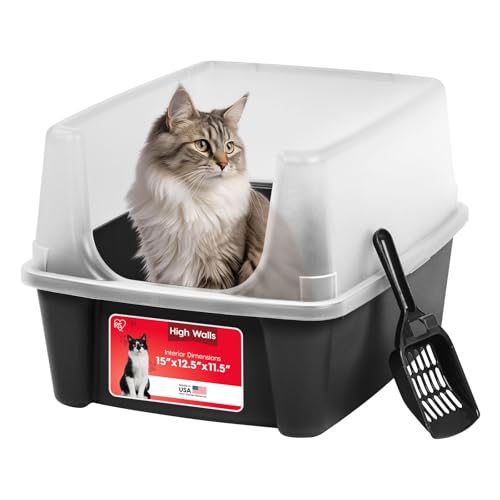
 IRIS Open-Top IRIS Open-Top | Manual | ~$19 | Tightest budgets |
 Exquisicat High-Sided Stainless Exquisicat High-Sided Stainless | Manual | ~$50 | Cats who spray/dig high |
| PetSafe ScoopFree | Auto (crystal litter) | ~$120–$200 | 1-2 cats, budget automation |
 Modkat Flip Modkat Flip | Manual, design-forward | ~$100 | Small-space aesthetics |
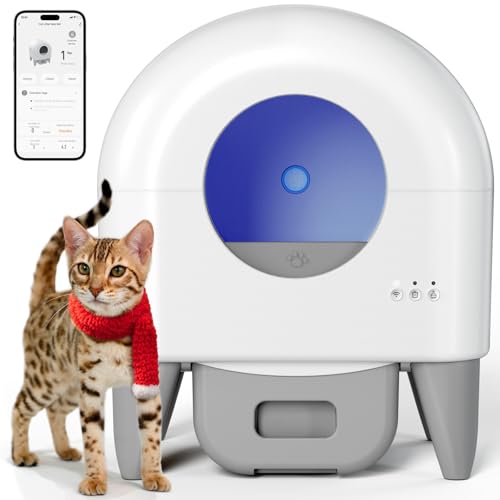 Fumoi Automatic Self-Cleaning Fumoi Automatic Self-Cleaning | Auto | ~$200 | Mid-range full automation |
 Oneisall Ease S1 Oneisall Ease S1 | Auto | ~$230 | Mid-range, app features |
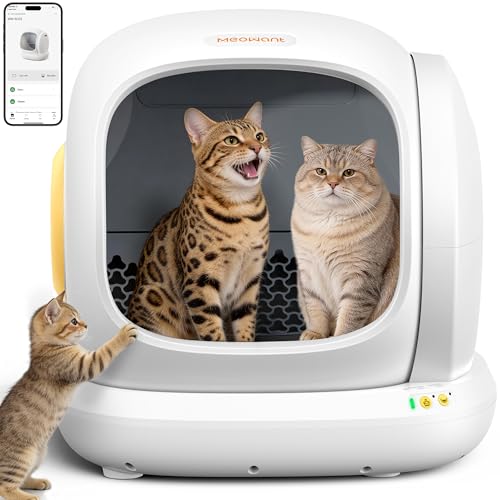 Meowant Smart Home Automatic Meowant Smart Home Automatic | Auto (WiFi) | ~$380 | Health tracking via app |
 PetSnowy Automatic PetSnowy Automatic | Auto (premium) | ~$529 | Multi-cat, heavy use |
 Litter-Robot 4 Litter-Robot 4 | Auto (category benchmark) | ~$699 | 3+ cats, long-term reliability |
*Prices fluctuate — confirm current pricing at checkout.
How to Choose: Brand-by-Brand Breakdown
Price alone doesn’t tell you which box fits your household. Here’s what actually separates these brands once you’re past the “manual vs. automatic” decision.
| Brand / model | Key benefit | Real cost | Best for |
|---|---|---|---|
| IRIS Open-Top | Simple, high-sided sides contain litter scatter without a lid — no moving parts to break | ~$19 one-time | First-time cat owners, backup box for the N+1 rule |
| Exquisicat Stainless | Stainless steel resists odor absorption better than plastic over years of use | ~$50 one-time | Cats who spray or dig aggressively against walls |
| PetSafe ScoopFree | Crystal litter + auto-rake means near-zero daily scooping without full robotics pricing | ~$120–200 hardware + crystal refills | 1-2 cats, owners who want automation but not a $700 commitment |
| Modkat Flip | Front-entry design traps litter better than most manual boxes, doubles as furniture-adjacent design | ~$100 one-time | Small apartments where the box needs to look intentional |
| Fumoi / Oneisall (mid-range auto) | App control and safety sensors at roughly a third of Litter-Robot’s price | ~$200–230 one-time | Budget-conscious buyers who still want full automation |
| Meowant (WiFi) | 75L extra-large capacity plus app-based waste tracking | ~$380 one-time | Multi-cat households wanting usage data without Litter-Robot pricing |
| PetSnowy (premium) | TiO2 odor control system is a genuine step up from standard carbon filters | ~$530 one-time | Odor-sensitive households, heavy multi-cat use |
| Litter-Robot 4 | Longest track record, largest community/support base, most-cited reliability over years of daily use | ~$699 one-time | 3+ cats, buyers who treat this as a 5+ year investment |
How to choose: If this is your first automatic box, start at the Fumoi/Oneisall price point — you get real automation without betting $700 on a category you haven’t tried yet. Step up to Litter-Robot only once you know multi-cat automation is a permanent part of your routine, since its price only makes sense amortized over years of daily use.
Open or Closed: What Do Vets Actually Recommend?
Direct answer: Contrary to popular belief, veterinary behaviorists generally favor open litter boxes over covered ones. Cornell University’s Feline Health Center notes that covered boxes trap ammonia from urine and bacteria inside, concentrating an odor cats find overwhelming even if they tolerate it out of necessity. Behaviorists at Royal Canin Academy have also linked covered-box use to stress-related conditions like feline idiopathic cystitis, since a covered box limits visibility and can make a cat feel cornered mid-use.
Worth noting: a study in Applied Animal Behaviour Science found no statistically significant group preference between styles when both were kept equally clean — but individual cats do show personal preferences either way. If your cat is avoiding the box, offering both an open and closed option (a litter box “cafeteria”) is a legitimate troubleshooting step before assuming it’s a health issue.
The Golden Rule: How Many Litter Boxes Do You Need?
Direct answer: The AAHA/AAFP-endorsed guideline, also backed by Cornell Feline Health Center research, is one litter box per cat, plus one extra — the “N+1 rule.” Two cats need three boxes, three cats need four, and so on. The American Association of Feline Practitioners frames litter boxes as a key territorial resource; competition over too few boxes is a documented driver of stress-related elimination problems in multi-cat homes.
Where Not to Put a Litter Box
Direct answer: Avoid high-traffic areas, right next to food and water bowls, and anywhere loud or vibrating (near a washing machine or furnace). Cats want privacy and a predictable, quiet space — a box placed somewhere stressful is one of the most common causes of a cat avoiding it entirely, which owners often mistake for a medical problem before checking placement first.
Automatic vs. Manual: Is the Price Difference Worth It?
Direct answer: It depends entirely on your schedule and how many cats you have. For one cat and a consistent daily routine, a well-chosen manual box does the job for a fraction of the cost. Automatic boxes earn their price back in busy multi-cat households or for owners who travel often — the $200–$700 gap between tiers roughly maps to how much daily upkeep you’re paying to eliminate.
What Litter Should You Use in an Automatic Litter Box?
Not every litter works safely in a mechanical box — the wrong type can jam rakes, clog sensors, or void your warranty. Here’s what actually works by system type:
- Clumping clay (Litter-Robot, most rake-style boxes): the standard choice. Look for lightweight, low-dust clumping clay — heavy clay increases wear on the motor over time. This is what Litter-Robot officially recommends for its Globe.
- Crystal/silica litter (PetSafe ScoopFree, some tray-style boxes): required, not optional, for crystal-tray systems — they’re built around the crystal’s absorb-and-dry mechanism rather than a rake.
- Tofu litter: flushable and lightweight, but many owners report it clumps too softly for rake mechanisms to reliably pull — check your specific model’s manual before switching.
- Avoid: pine pellets, walnut shell, and anything with large chunks or uneven granule size in rake-style boxes — inconsistent clump size is the #1 cause of jams and false-cleaning-cycle errors.
How the Big Automatic Names Compare
Beyond the models reviewed above, three brands come up constantly in 2026 searches:
- Litter-Robot (made by Whisker): the rake-and-globe category leader by a wide margin — the brand name “Whisker” itself gets searched more than any competitor term. The Litter-Robot 4 (~$700) is the long-running favorite; the newer Litter-Robot 5 adds a larger globe opening and updated app, at a similar price point.
- PetKit Pura Max / Pura Max 2: a mid-range rake-style competitor, generally $250-350, with app-based waste tracking similar to Litter-Robot at a lower price.
- CatLink and Neakasa: newer entrants, typically $300-450, both rake-style with companion apps — fewer long-term reviews than Litter-Robot or PetKit, so treat early ratings with some caution.
Frequently Asked Questions
What litter box do vets recommend?
No single product — but many veterinary behaviorists favor open boxes over covered ones, sized appropriately, kept clean, and following the one-per-cat-plus-one rule.
Do cats prefer closed or open litter boxes?
Most cats do better with open boxes — better airflow, less trapped odor, and full visibility of their surroundings while vulnerable.
What is the golden rule for litter boxes?
One litter box per cat, plus one extra (the “N+1” rule) — two cats need three boxes.
Where should you not put a litter box?
Avoid high-traffic areas, spots next to food/water, and loud or vibrating locations like near a washing machine.
Is a Litter-Robot worth the price over cheaper automatic boxes?
For 3+ cat households or anyone prioritizing long-term reliability and app-based health tracking, yes. For 1-2 cats on a budget, mid-range automatic options like Fumoi or Oneisall deliver most of the same core benefit for less.
Why does my cat poop outside the litter box?
The most common causes are a dirty box, the wrong litter type or depth, a box that’s too small or covered, box placement in a high-traffic or stressful spot, or — if the behavior is sudden — a medical issue like a UTI or arthritis that makes stepping into the box painful. Rule out a dirty box and bad placement first (see the “Where Not to Put a Litter Box” section above); if the problem persists or comes on suddenly, a vet visit is the next step.
How often should you change a cat litter box?
Scoop solid waste and clumps daily. For clay or clumping litter, do a full dump-and-clean of the box every 1–2 weeks; for crystal or automatic-box litter, every 3–4 weeks is typical. Multi-cat households need more frequent full changes than the general guideline suggests — when in doubt, smell test the box daily and change it sooner rather than later.
Where should you put a litter box in a small apartment?
A bathroom corner, a covered nook in a closet with airflow, or a dedicated spot behind furniture all work — the requirement is quiet, low-traffic, and away from food/water, not square footage. A litter box furniture piece (see the comparison table above) is a popular small-apartment solution since it hides the box in a side table or bench.
How often should you clean a cat litter box (full wash)?
Beyond daily scooping, wash the box itself with mild soap and warm water every 1–2 weeks for manual boxes. Avoid harsh chemical cleaners or bleach — the smell can drive cats away from the box entirely, which defeats the purpose of cleaning it.
How big should a cat litter box be?
As a rule of thumb, the box should be at least 1.5 times your cat’s length from nose to tail base. Many off-the-shelf boxes run too small for adult cats — sizing up is one of the simplest, cheapest fixes for a cat that’s avoiding the box or hanging half out of it.
Related on CoquiPaws: PetSafe ScoopFree Litter Box Review — our full deep-dive on the budget automatic pick from this guide.
MORE FROM COQUIPAWS
- PetSafe ScoopFree Litter Box Review — a deep dive on one of the picks mentioned above
- Best Automatic Cat Feeders 2026 — keep the rest of your cat care routine on autopilot too
- Catit Flower Fountain Review — hydration matters as much as litter hygiene for urinary health
One smart pet email a week.
No spam. No paid endorsements. Just one honest review or guide every Monday — starting with our free safety guide: «27 Toxic Things Hiding in Your Pet's Home».