
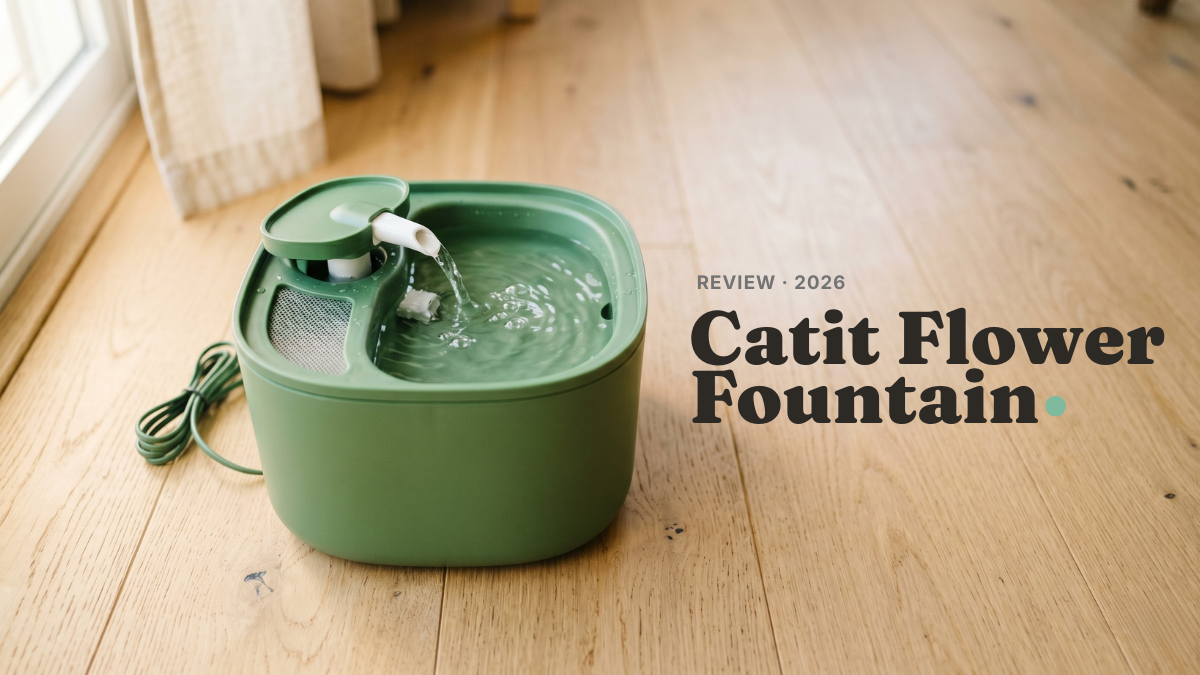
REVIEW
Some links in this article are affiliate links. If you buy through them, I earn a small commission at no extra cost to you. I only recommend products I’ve tested or thoroughly researched.
This review is based on extensive research, analysis of hundreds of verified customer reviews, manufacturer specifications, and veterinary sources. We have not personally tested this product.

I’ve spent the last few weeks digging into the Catit Flower Fountain. Verified buyer reviews, manufacturer specs, veterinary literature on feline hydration — the works. The reason? It’s one of the most recommended budget cat fountains on Amazon, but the picture is messier than the marketing suggests. Some cats drink from it for years. Others ignore it after a week. So who’s right?
Quick Answer
The Catit Flower Fountain is a solid entry-level pick at $35.99 (May 2026 Amazon price) for cats who reject still water but don’t need silent operation. Its 3L reservoir, triple-action filter, and 3 flow settings work well for most picky drinkers, earning 4.3 stars across 49,276 verified reviews. However, it requires weekly cleaning to avoid pump noise and biofilm, and the all-plastic build is a known trigger for feline chin acne. Skip it if you want stainless steel hygiene or near-silent operation.
Table of Contents
- Why cat fountains matter (the veterinary case)
- Catit Flower Fountain specifications at a glance
- What 49,000+ Amazon reviewers actually say
- The 3 flow settings explained
- Triple-action filter: does it work?
- The biggest complaints (and how to avoid them)
- Catit Flower vs. Catit Stainless Steel vs. PetSafe Drinkwell Original
- Pros and cons
- Who is this fountain for?
- FAQ
- Final verdict
Why Cat Fountains Matter: The Veterinary Case for Running Water
Before judging any fountain, it helps to understand why this purchase matters at all. Cats evolved as desert hunters. Their thirst drive is famously weak.
According to the Cornell Feline Health Center, cats need roughly 4 ounces of water per 5 pounds of lean body weight daily. That’s about one cup for a 10-pound cat. Most pet owners have no idea how much their cat actually drinks.
The stakes aren’t theoretical. The Cornell Feline Health Center identifies Feline Lower Urinary Tract Disease (FLUTD) as the number one reason cats visit veterinary practices, and notes it is most frequently seen in middle-aged, indoor, overweight cats that drink less water. Increased hydration produces more dilute urine, which reduces bladder irritation and lowers the concentration of crystals that can lead to urethral plugs.
Cornell’s own guidance on hydration acknowledges that some cats increase their intake of water when provided with water fountains, but individual preferences among cats for these varies. Translation: fountains help, but there’s no guarantee any specific cat will love any specific fountain. This is the single most important framing for the Catit review below.
Catit Flower Fountain Specifications
Per Catit’s official product page and Amazon listing:
| Spec | Detail |
|---|---|
| Capacity | 3 L / 100 fl oz |
| Dimensions | 8.3 x 8.3 x 7.3 in (21 x 21 x 18.5 cm) |
| Weight | 1.32 lb / 590 g |
| Power | 120V, 60Hz, 300mA (North America) |
| Flow settings | 3 (gentle surface, flower stream, bubbling top) |
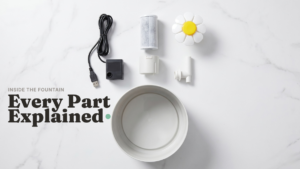
| Filter | Triple Action (cotton mesh + activated carbon + ion exchange resin) |
| Material | BPA-free plastic |
| Color | Green & white (original) |
| Price | $35.99 (Amazon, May 2026) |
| Rating | 4.3⭐ / 49,276 verified reviews |
What 49,000+ Amazon Reviewers Actually Say
We analyzed the distribution and content of verified Amazon reviews to identify recurring themes rather than cherry-picked anecdotes. With a 4.3-star average across 49,276 reviews, here’s what came up most often.
The praise (roughly 70% of reviews, 4-5 stars)
The most common positive observations cluster around four points. First, increased drinking. Owners consistently report their cats drinking more often after switching from a bowl, sometimes within days. Second, low price relative to alternatives — most premium cat fountains start above $50.
Third, the design is genuinely whisker-friendly. The drinking surface is wide and open, which matters because the Cornell Feline Health Center notes whisker stress (when whiskers touch bowl sides) can deter eating and drinking in sensitive cats. Fourth, the 3L capacity means most single-cat households can refill every 4-7 days.
The complaints (roughly 30% of reviews, 1-3 stars)
The criticisms are remarkably consistent. Pump noise after 2-4 weeks of use is by far the most frequent complaint. The cause is almost always biofilm or hair buildup in the pump — solvable with weekly cleaning, but not obvious to first-time fountain owners.
Cat refusal is the second most common complaint. Some cats simply won’t drink from any fountain. This matches Cornell’s caveat that fountain preferences vary by individual.
Plastic-related chin acne is a recurring concern. Feline chin acne is a documented condition linked to plastic dishes, per AVMA-aligned veterinary literature, and the Catit’s all-plastic drinking surface is a known trigger for sensitive cats. Catit themselves market a Stainless Steel Flower Fountain partly on this basis.
The 3 Flow Settings Explained
The “3 settings” claim is real but specific. Per Catit’s official documentation:
- Gentle surface flow — plug in the fountain with no accessories. Water flows out and across the wide top surface. Good for cats new to fountains.
- Flower stream — insert the included flower accessory. Creates long, faucet-like streams. This is the visual most cats respond to.
- Bubbling top — add the flower cap. Tones down the streams into a soft bubble. Useful if your cat plays with the water instead of drinking it.
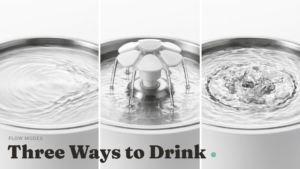

The flower stream is the most-cited setting in positive reviews because it triggers the visual-motion response that draws cats to running water in the first place.
Triple-Action Filter: Does It Actually Work?
Catit’s Triple Action Filter has three components, per the manufacturer:
- Cotton mesh (outer layer) — catches hair, sediment, and visible debris.
- Activated carbon — removes odors and impurities. Activated carbon is a standard, well-documented water filtration material used in countless household systems.
- Ion exchange resin — softens water by removing excess calcium and magnesium.
The third component matters more than it sounds. Cornell and AVMA-aligned literature both note that excess minerals in feline urine can contribute to crystal formation and urinary tract issues. Softer water means lower mineral load. We have not found independent lab testing of the specific reduction percentages, but the filter design follows the same principles used in standard household water softening.
Important: Catit recommends replacing the filter every 30 days or sooner if visibly saturated.
Official Catit filters vs. generic compatible filters
This is worth flagging clearly. On Amazon, you’ll find two categories of replacement filters:
- Official Catit Triple Action filters — manufactured by Catit, follow the original triple-layer spec exactly. Higher price.
- Generic compatible filters — third-party brands that fit the Flower Fountain housing. The most popular option is an 8-pack at around $12.39 (May 2026).

The generic packs are dramatically cheaper, but quality varies. Independent third-party filters are NOT certified by Catit, and Catit explicitly states their fountains are only for use with certified Catit filters, which are guaranteed to be safe and effective. Whether to use generics is a personal call: many Amazon reviewers report no issues, but you’re trading manufacturer-tested filtration for cost savings. If your cat has urinary tract history, we’d stick with official Catit filters.
The Biggest Complaints (And How to Avoid Them)
1. Pump noise after a few weeks
This is the single most common complaint in negative reviews. The cause is almost universal: cat hair, biofilm, or food debris clogging the pump intake. The fix from owners who’ve used the fountain for years:
- Disassemble the pump every 7-10 days.
- Rinse the impeller (the spinning piece) under warm water.
- Soak in a 1:1 white vinegar solution monthly to dissolve mineral buildup.
- Keep water level above the minimum line — running dry burns out pumps.
2. Cat won’t drink from it
If your cat ignores the fountain after 1-2 weeks, try placing it in a different location away from the food bowl. Cornell-aligned behavioral guidance suggests cats often avoid drinking next to food, possibly an evolutionary holdover from avoiding contaminated water near prey carcasses.
3. Chin acne risk
If your cat develops black specks on the chin, the plastic surface may be the cause. Switching to the Catit Stainless Steel Flower Fountain (same base, stainless top) is the manufacturer’s own recommended fix.
4. Splashing
Some cats are aggressive drinkers. Use the bubbling-top setting to reduce splash. A silicone placemat under the fountain protects flooring.
Catit Flower vs. Catit Stainless Steel vs. PetSafe Drinkwell Original
The Catit Flower doesn’t exist in a vacuum. Two alternatives come up constantly in buyer comparisons.
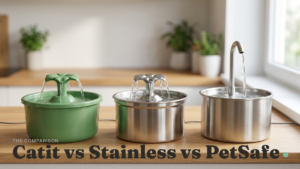
| Feature | Catit Flower (Original) | Catit Stainless Steel | PetSafe Drinkwell Original |
|---|---|---|---|
| Capacity | 3L | 3L | 1.4L (50 oz) |
| Drinking surface | BPA-free plastic | Stainless steel | Plastic + vertical stream |
| Flow type | 3 settings | 3 settings | Single vertical stream |
| LED nightlight | No | Yes | No |
| Filter type | Triple Action | Triple Action | Carbon |
| Best for | Budget single-cat | Sensitive skin | Vertical stream lovers |
| Price (May 2026) | $35.99 | $40.94 | $75.99 |
The verdict from comparison: if your cat fits the plastic-tolerant profile, the original Catit Flower at $35.99 delivers most of what the Stainless Steel offers for $5 less — but at that small price gap, the Stainless Steel ($40.94) is genuinely worth the upgrade if you have any concern about chin acne. The PetSafe Drinkwell Original is a different category entirely: it’s a small-capacity vertical-stream fountain at $75.99, best suited for cats or medium-sized dogs that specifically prefer drinking from a falling stream rather than a flat surface.
Pros and Cons
Pros
- Among the lowest-priced 3L cat fountains on the market ($35.99, May 2026)
- 4.3-star average across 49,276 verified reviews
- 3 distinct flow settings genuinely appeal to different cat preferences
- Triple-action filter includes ion exchange resin (rare at this price point)
- Whisker-stress-free open drinking surface
- 3L capacity reduces refill frequency to 4-7 days for single-cat homes
- BPA-free plastic
- Replacement filters widely available; generic 8-packs from ~$12.39
- Backed by a manufacturer with established cat fountain track record
Cons
- All-plastic drinking surface can trigger chin acne in sensitive cats
- Pump requires weekly cleaning to avoid noise complaints
- Cord length may force fountain placement near outlets (no battery option)
- No LED nightlight on the original model
- Filters must be replaced every 30 days
- Stainless Steel version is only $5 more — making the upgrade tempting
- Some buyers report pump failure after 12-18 months
Who Is This Fountain For?
Buy the Catit Flower Fountain if you:
- Have 1-2 cats with no skin sensitivities to plastic
- Want to spend under $40 on your first cat fountain
- Are willing to clean the pump weekly
- Have a cat that ignores still bowl water
- Want a fountain small enough to fit in tight kitchen corners
Skip it if you:
- Already know your cat has chin acne or plastic sensitivity (get the Stainless Steel — only $5 more)
- Want a vertical falling stream specifically (consider the PetSafe Drinkwell Original)
- Want a silent fountain you can put in your bedroom
- Travel frequently and can’t commit to weekly cleaning
- Want LED features (get the Catit LED Flower Fountain)
FAQ
Is the Catit Flower Fountain safe for cats?
Yes. It’s made of BPA-free plastic per manufacturer specifications, and the triple-action filter actively softens tap water. The main safety concern is hygiene: stagnant or biofilm-coated water can harbor bacteria. The Cornell Feline Health Center recommends fresh, clean water in multiple accessible locations, which means weekly fountain cleaning is non-negotiable.
How often do I need to change the Catit filter?
Catit recommends every 30 days, or sooner if the filter appears visibly saturated or discolored. Official Catit filters are manufacturer-certified; generic compatible 8-packs run around $12.39 in May 2026. For cats with urinary tract history, stick with official Catit filters.
Does the Catit Flower Fountain make cats drink more water?
It can, but not guaranteed. Cornell’s hydration guidance explicitly states fountain preferences vary by individual cat. Most Amazon reviewers report increased drinking; a minority report no change.
Is the Catit Flower Fountain noisy?
When new and clean, it produces a soft running-water sound — quieter than a bathroom faucet. Noise complaints overwhelmingly stem from clogged pumps after weeks of use. Weekly pump cleaning prevents nearly all noise issues.
Is the $5 upgrade to the Stainless Steel version worth it?
For most buyers, yes. At $40.94 vs. $35.99, the Stainless Steel version adds a dishwasher-safe stainless drinking surface (reducing chin acne risk) and an LED-backlit water level window. Unless budget is the absolute priority, the Stainless Steel is the smarter long-term buy.
How do I clean the Catit Flower Fountain properly?
Disassemble completely. Wash the reservoir, flower top, and pump housing with mild dish soap and warm water at least once a week. The pump impeller should be removed and rinsed separately. Monthly, soak removable parts in a 1:1 white vinegar solution to dissolve mineral deposits. Do not use bleach or abrasive scrubbers.
Catit Flower Fountain not working — what should I check first?
Start with the three most common causes, in order of likelihood: the pump impeller is clogged with hair or biofilm (unplug, disassemble, and rinse it under warm water), the water level has dropped below the minimum fill line (running dry can burn out the pump), or the filter is old and restricting flow (replace every 30 days). If the fountain still won’t run after checking all three, verify the outlet works and the power adapter is fully seated — pump failure after 12-18 months does happen, per verified reviews, and is the last thing to rule out.
How do I set up the Catit Flower Fountain for the first time?
Wash all parts before first use, then assemble in this order: pump into the base, filter into the housing, reservoir on top, and your chosen flow accessory (flat, flower, or bubble cap) last. Fill past the minimum line, plug in, and let it run a few minutes before your cat approaches — the flow needs a moment to settle and stop sputtering air bubbles.
Catit Flower Fountain vs. Senses 2.0 vs. Pixi: Which Model?
Direct answer: The original Catit Flower Fountain (this review) is the budget pick at ~$24.96–$35.99. The Catit Senses 2.0 Flower Fountain adds a taller flow tower and a slightly larger 3L reservoir for roughly $32–$42, aimed at cats who prefer a higher water stream. The Catit Pixi Fountain (~$39.99) drops the flower shape entirely for a stainless-steel-topped, more minimalist design — better for owners who want to avoid an all-plastic build without paying for a full premium fountain. If your cat already likes flower-style fountains and budget is the deciding factor, stick with the original reviewed here.
Common Search Questions About Catit Drinking Fountains
A few questions come up often enough in reviews and forums that they deserve direct answers here, since this Catit drinking fountain and Catit water fountain review already covers the product in depth:
- Do vets recommend cat water fountains? Many do, primarily because cats are prone to under-drinking from still water — moving water encourages more frequent drinking, which supports urinary and kidney health over time.
- What is the safest cat water fountain? Look for BPA-free plastic or stainless steel, a filter that’s easy to access and replace, and a design without small gaps where mold or biofilm can hide. The Catit Flower Fountain meets the first two criteria but needs weekly cleaning to stay ahead of the third.
- How often should I replace my Catit fountain filter? Every 2–4 weeks under normal use, sooner in multi-cat households. A filter left too long is the most common cause of pump noise and cloudy water.
Final Verdict
The Catit Flower Fountain earns its 4.3-star rating across nearly 50,000 verified reviews, but with one important caveat the marketing doesn’t mention: at $35.99, it’s only $5 cheaper than its own Stainless Steel sibling ($40.94). That changes the recommendation.
If you’re absolutely budget-locked, the original Catit Flower at $35.99 is a smart pick for one or two healthy cats willing to commit to weekly pump cleaning. But if you can stretch another $5, the Stainless Steel version eliminates the chin acne risk and adds a water level indicator — making it the better long-term value for most buyers.
The PetSafe Drinkwell Original at $75.99 is a different recommendation entirely: choose it only if your cat specifically prefers a vertical falling stream.
At any of these prices, the underlying logic holds. Cornell identifies low water intake as a major contributor to the number one reason cats visit veterinarians. Whichever fountain fits your situation, getting one is the smart play.
→
Author: CoquiPaws Editorial Team · Last updated: May 18, 2026
Sources: Cornell Feline Health Center, American Veterinary Medical Association, Catit official product documentation, analysis of 49,276 verified Amazon customer reviews.
Looking for other options? See our full Best Cat Water Fountains 2026 comparison — stainless steel, ceramic, and budget picks.
Frequently Asked Questions
Is the Catit Flower Fountain actually worth it?
For most single-cat households, yes — it’s one of the better budget picks in the category. It’s not as quiet or as low-maintenance as pricier stainless steel models, but at its price point it beats plain bowls for encouraging water intake, and replacement filters are cheap and widely available. If you have multiple cats or want something dishwasher-safe, look at the stainless steel version instead.
What do people say about the Catit Flower Fountain on Reddit?
The most common Reddit feedback: the pump is louder than expected out of the box but quiets down after the first deep clean, cats generally prefer the top stream over the bowl, and the plastic scratches/clouds over time — which is why heavy users often upgrade to the stainless steel version after 6-12 months.
How is the Catit Senses 2.0 Flower Fountain different from the original?
The Senses 2.0 line is the same core pump and flower-stream design, just packaged under Catit’s wider “Senses 2.0” ecosystem (which also includes feeders, scratchers, and treat mazes). Functionally, the fountain itself is nearly identical — same 3L capacity, same triple-action filter, same flow settings.
How often do you need to clean the Catit Flower Fountain?
Manufacturer guidance is a full clean every 2-4 weeks and a filter change every 2-4 weeks depending on your water hardness and number of cats. In practice, most owners find a quick weekly rinse of the flower top prevents the slime buildup that’s the fountain’s most common complaint.
Is there a stainless steel version of the Catit Flower Fountain?
Yes — Catit sells a stainless steel top insert (sold separately, around -10) that fits the same base and is far more scratch- and odor-resistant than the plastic top, though the base itself remains plastic.
MORE FROM COQUIPAWS
- PetSafe ScoopFree Litter Box Review — another low-maintenance pick to pair with a fountain
- Best Automatic Cat Feeders 2026 — round out an automated feeding-and-hydration setup
- Tractive GPS Cat Tracker Review — keep tabs on outdoor cats who might skip the fountain at home
One smart pet email a week.
No spam. No paid endorsements. Just one honest review or guide every Monday — starting with our free safety guide: «27 Toxic Things Hiding in Your Pet's Home».